
I previously posted about the ratio between Gold and Silver and a potential investing opportunity. At the time Gold was ~4000.00 USD and ounce and Silver was ~$49 USD and ounce — a ratio of 82:1.
Since that post, Gold has increased $1000/oz and Silver has doubled to over $100/oz, making the ratio ~43:1. I expect this ratio to go to 15:1 in the future.
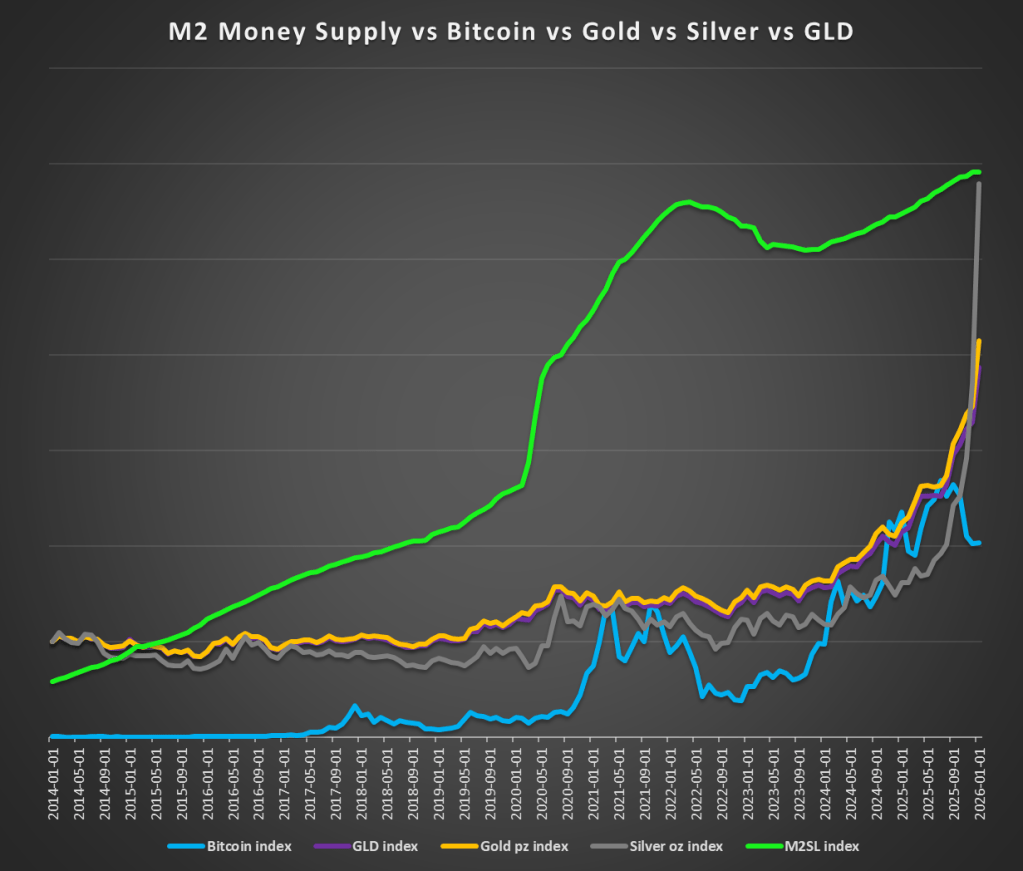
I thought it would be interesting to chart the prices of different metrics against one another to see any trends. I decided it use the M2 Money Supply, Gold, Silver, GLD Stock and Bitcoin.
Here are short descriptions of each:
M2 Money Supply
M2 is a broad measure of how much money exists in the economy. It includes cash, checking accounts, savings accounts, and other easily accessible funds. When M2 grows, it usually means more money is circulating, which can affect inflation, asset prices, and purchasing power. Think of M2 as the fuel level of the financial system.
Gold (Commodity)
Gold is a physical commodity that has been used as money and a store of value for thousands of years. It doesn’t corrode, is scarce, and isn’t tied to any single government. Investors often turn to gold during periods of inflation, currency devaluation, or economic uncertainty. Gold tends to be seen as a long-term hedge against loss of purchasing power.
Silver (Commodity)
Silver is both a precious metal and an industrial commodity. Like gold, it has monetary history and is used as a store of value, but it also has significant demand in manufacturing, electronics, and renewable energy. Because of this dual role, silver prices can be more volatile than gold, reacting to both economic growth and financial stress.
GLD (Gold ETF)
GLD is a stock that represents ownership in a trust holding physical gold. It is designed to track the price of gold without requiring investors to store or insure the metal themselves. Unlike owning physical gold, GLD is traded on the stock market and can be bought or sold instantly. While GLD closely follows gold prices, it carries market-based risks and does not provide direct possession of the metal.
Bitcoin
Bitcoin is a digital asset with a fixed supply that exists entirely online. It operates without a central authority and relies on a decentralized network to verify transactions. Many investors view Bitcoin as a modern, digital alternative to gold — a hedge against inflation and monetary expansion. Unlike commodities, Bitcoin has no physical use, but its scarcity, portability, and independence from traditional financial systems give it unique value.
I charted the prices since 2014 by month and indexed each value
Anything jump out at you?
Other than the recent spikes in Gold and Silver, Bitcoin seems to be lagging. Since 2014 the price of Bitcoin had a correlation of .78 and since the beginning of the year has dropped to .18. Daily price close data for this would be much more useful, and this correlation is not statistically significant, but still interesting as a rough gauge.
The big question is — is Bitcoin de-coupling from the M2 money supply, or is Bitcoin poised for a imminent rally? My guess is that Bitcoin will soon increase to follow the M2 money supply.
Why it’s lagging is also speculation, likely the recent uptick in Gold and Silver. Retail money is flooding into commodities and leaving Bitcoin behind.




 Kylelar Maravich Business Page
Leave a comment